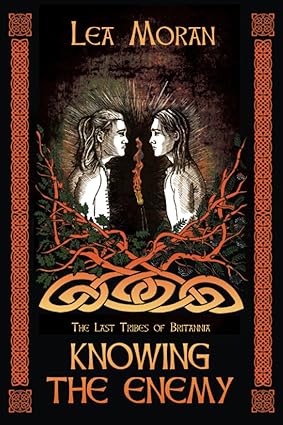
I love stories about ancient Britain and Lea Moran does an excellent job of creating a tale set in those times, which draws on the uncertainty between tribes and the fight for dominance as well as the fear of invasion from outsiders.
The constant threat of war and the prospect of violence is the backdrop to Luca’s story which is a very human tale of identity and rivalry and coming-of-age. The book begins with an incident which leads us into the exploration of one of the key relationships which Luca has in the book, with his brother Kennan. The situation in which the brothers find themselves is a great way to start a book and pique the curiosity of the reader as Moran starts at the end point, the narrative then leading us to where we first find ourselves through the retelling of Luca’s personal history. The narrative may be skewed to Luca’s recollections only but he feels like a safe voice with little agenda.
Luca lives in a small village in what would now be Gloucestershire in England with his mother, father and Kennan, as well as Minura, his sister. It is clear that Lucanus, Luca’s father favours Kennan and through the course of the book, we learn gradually from where his enmity towards Luca arises.
Moran builds a picture of a simple life, Lucanus being a potter who makes enough money to feed his family, whose skills will be taught and passed on to the next generation. It is clear that Luca is different to the other siblings and this is emphasised when Luca is sent to the monastery to learn to read with Father Faustus. Here, Luca encounters, from the monk, exposure to a differing view of the world around him which is counterbalanced by his contact with Veryan Hen, the village healer.
As Luca and Kennan’s lives become more diverse, the gap between them increases. Moran shows how small gripes and separations can become compounded over time until they become insurmountable. Along with sibling rivalry, Luca also has to contend with questions of identity and loss of loved ones as well as navigating the difficult teenage years and the attractions these hold.
A final confrontation seems inevitable but it is driven by one thing which I will leave you to discover.
A good historical novel, well-written with flowing prose and clear characterisation.
I would recommend.
I love stories about ancient Britain and Lea Moran does an excellent job of creating a tale set in those times, which draws on the uncertainty between tribes and the fight for dominance as well as the fear of invasion from outsiders.
The constant threat of war and the prospect of violence is the backdrop to Luca’s story which is a very human tale of identity and rivalry and coming-of-age. The book begins with an incident which leads us into the exploration of one of the key relationships which Luca has in the book, with his brother Kennan. The situation in which the brothers find themselves is a great way to start a book and pique the curiosity of the reader as Moran starts at the end point, the narrative then leading us to where we first find ourselves through the retelling of Luca’s personal history. The narrative may be skewed to Luca’s recollections only but he feels like a safe voice with little agenda.
Luca lives in a small village in what would now be Gloucestershire in England with his mother, father and Kennan, as well as Minura, his sister. It is clear that Lucanus, Luca’s father favours Kennan and through the course of the book, we learn gradually from where his enmity towards Luca arises.
Moran builds a picture of a simple life, Lucanus being a potter who makes enough money to feed his family, whose skills will be taught and passed on to the next generation. It is clear that Luca is different to the other siblings and this is emphasised when Luca is sent to the monastery to learn to read with Father Faustus. Here, Luca encounters, from the monk, exposure to a differing view of the world around him which is counterbalanced by his contact with Veryan Hen, the village healer.
As Luca and Kennan’s lives become more diverse, the gap between them increases. Moran shows how small gripes and separations can become compounded over time until they become insurmountable. Along with sibling rivalry, Luca also has to contend with questions of identity and loss of loved ones as well as navigating the difficult teenage years and the attractions these hold.
A final confrontation seems inevitable but it is driven by one thing which I will leave you to discover.
A good historical novel, well-written with flowing prose and clear characterisation.
I would recommend.
 Scuffed Granny