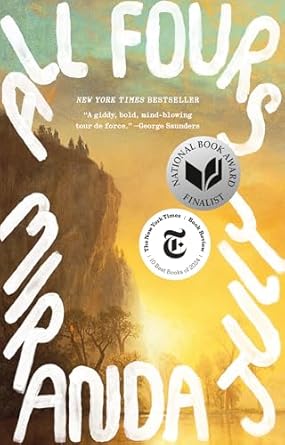
I’ve thought a lot about this book since I’ve finished it. My initial summary of it was “This book isn’t meant for me” but the more that I’ve mulled this over in order to write this review, the more I’ve realised that it is a book that I’m glad I’ve read.
Let me explain. The main character of the book is an artist, multiple media, who is planning a trip to New York – a road trip. She is married to Harris and they have a child, Sam. She never makes it to New York, stopping in Monrovia outside L.A. and holing up in a motel. She’s 45 and the immediate assumption is that she’s having a mid-life crisis of some sort as she meets someone and lies to her husband and child about her whereabouts for 3 weeks.
There is an element of this being about reaching mid-life and thinking, “Is this it?” But I think that there are deeper issues on which the story is built and in this, it is a novel for our times.
Our narrator is never named and I didn’t realise this until I wrote this review. It obviously wasn’t important to my understanding but I do think that its exclusion has a bearing on the meaning of the book. A lot of what it explores would fall under the category of identity: who are we and how are we defined? Our narrator remaining unnamed reinforces this idea, I think.
Our narrator is successful in her fields but there is a sense that she is playing a role which has been given to her through the choices that she has made herself but also in the way that her life as a woman has unfolded. She has had trauma and is still experiencing flashbacks from that. As it is linked to Sam and the way that they came into the world, it is not something from which she can easily escape.
Adding to this theme of “how are we defined”, Sam is referred to as “they”, their gender identity fluid and there are no indications in the text as to whether Sam is a boy or a girl. I liked this for its representation of the times in which we are living and the fact that this reflects in its purest form what our narrator is trying to do – to unbox herself.
And how can you do that once those delineations have been placed? How do you shuck them off? It’s not easy if it’s what society expects.
But what if you could step out of this life that you have and explore? This is what happens in Monrovia – impulsively but with a compulsion that she is unable to stop, she finds someone unlikely in a young man called Davey with whom she connects on a level never contemplated before and it sends her reeling, putting everything that she already has in jeopardy.
This novel makes for an interesting read which is thought-provoking. It is also one of those books which shakes you up a little and I think that this is purposeful, it is July’s intent.
It’s not that I identified with our narrator: I didn’t really recognise anything of myself in the character although she’s funny and intelligent and passionate and impulsive. I felt like I was in the company of someone who I liked and admired but who felt a little bonkers. But that are aspects of her life as a woman and the expectations of that, that resonated with me and it was these moments in the text where I felt most reflective. I did feel though that it is a book for our times, that it’s holding up a mirror to family life and women’s roles and usurping them in ways that some may find bold and which will certainly undermine how we should see mothers. But I found this rather exciting.
Would I read more Miranda July? Yes, I probably would but I’d be better prepared for its wildness next time.
Rachel Rating: 4 out of 5 stars
 Scuffed Granny