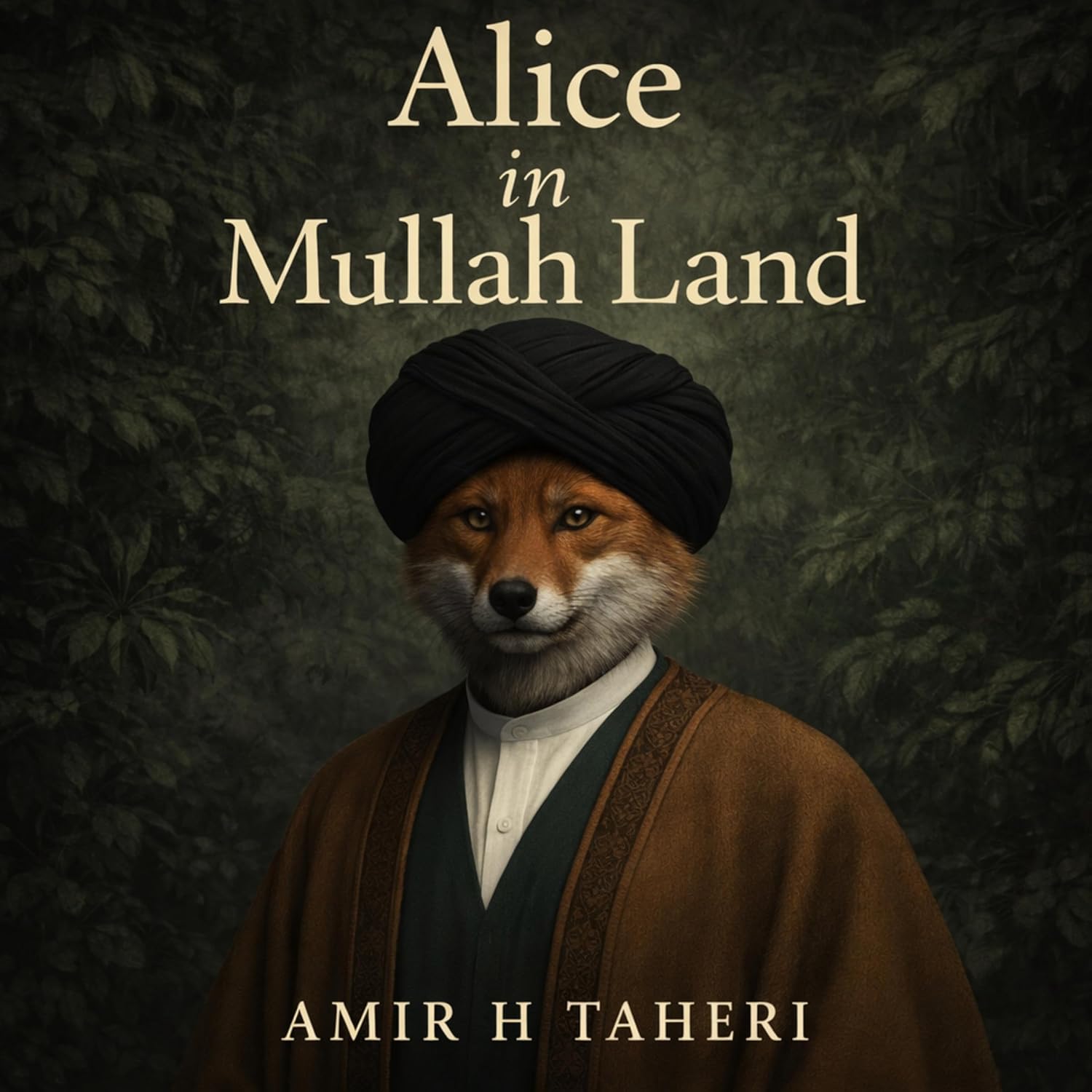
I really like what Amir H. Taheri has done in Alice in Mullah Land. He has taken a well-known story and contorted its idea into something all of his own. Taheri’s version has elements of Lewis Carroll’s classic and yet, it is a novel concerning itself much more with our own world whilst masquerading as something created from imagination.
Alice is a young woman who is in a sort of limbo. She is not really sure what she would like to do and although she is comfortable in that she lives with her parents, her increasingly fractious relationship with her father is a cause of discord. There is much that she doesn’t know about him and this leads to misunderstanding and tension between them. If only her father would open up to her so she could see some of the things that he has seen, then maybe the new perspective that would offer her could allow more harmonious interactions between the two of them.
However, before this can happen, Alice is transported into a world very different to her own, one which mirrors the Middle Eastern world in which her father once worked: it is a place of religious oppression, where women are marginalised and limited; power is held and abused by the few for their own gain; the masses live in fear and do not rise up, as reprisals are swift and brutal against those who dare to challenge.
Taheri allows us to follow Alice into a regime determined to subdue and control no matter what. Different factions of people display as humans with the heads of animals e.g. mullahs are foxes, their henchmen are wolves or pigs, the masses are rabbits. We meet some of the people who live in this world, mainly “rabbits” – but are they all as timid as they appear?
There’s no doubt this is a tense book in places. The plot is linear and it’s easy to read but more than that, it is thought-provoking, earning from me a 4 star rating. It may be an allegory born of imagination but there’s a lot here which mirrors the reality of life for some people, in countries who use religion as a means to control and divert attention away from their leaders’ grasping and corrupt activity. Fiction can sometimes create a window to provide understanding – Tahiri’s fiction does.
A book for our times.
Rachel Rating:

