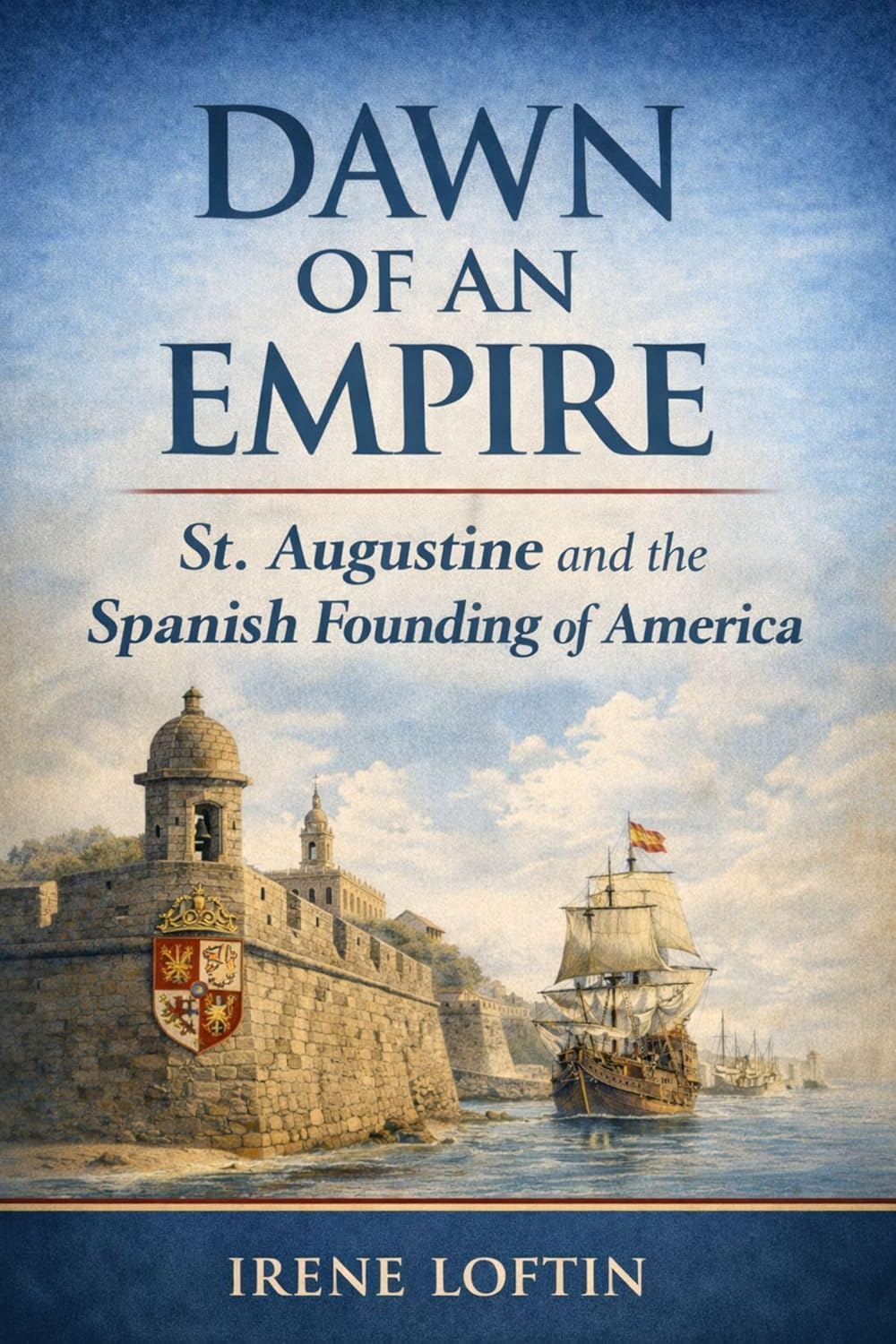
Who knew the Spanish were the first European colonists of North America? I mean, there’s been Italians i.e. Columbus and before him mention of Vikings, maybe not colonising but certainly setting foot there, but the Spanish? This I did not know and I’m betting that there will be a lot of readers who will be just as surprised as me.
Irene Loftin’s book sets out to rectify this and the first settlement, St. Augustine in Florida is her focus. We learn who the main players were in its history from kings to military men as well as who was there before the Spanish descended and how their arrival impacted the lives of the native tribespeople.
It has had a difficult history, St. Augustine, a place seen as important due to its proximity to the Caribbean but always being something of an outlier. Questions are always raised about whether it will be possible to defend and if the effort taken to do that will be justified in the long run. But it survived and this reader certainly had their curiosity piqued by its history and its previous significance.
I also learnt a lot about slavery and escaping to the south which contradicts what I always thought I knew about the underground railway. It’s these sorts of facts that I’m going to take away most from this book: its challenging of my particular view of history and how it’s made me see how our view of the past can be narrowed by a chosen lens.
This is not a heavy history book by any means, its style making it accessible to all. Loftin’s prose provides an overview of St. Augustine’s history with some illustrations breaking up the text, to support her words with a visual. Not all of them are cited; however, pictures of real historical figures are provided, like portraits painted, and cited and this adds validity to the ideas presented in the book.
The book finishes with a detailed timeline in the appendix which summarises the dates and events discussed in the book as well as further reading for more in depth study.
Those seeking an introduction to the origin of America as we know it today would learn much from using this book as a starting point.
Rachel Rating:
This review was first published on Reedsy Discovery where I was privileged to read it as an ARC.

